Category: Uncategorized
1/31/2024 – Quintuple Website Review
Hurricane Digital Memory Bank
What I enjoyed:
- I loved the randomly generated feature images and stories! Great way to bring people in
- The acknowledgement of the place based nature of the topic and how it connects with the community there was very important to include
- It was a very self paced and explorative website instead of a single page scroller
- The search works well for specifics and tags due to captions for every piece of data submitted,
What could be changed:
- None of the videos worked 🙁
Searching for Residential Schools
What I enjoyed:
- This was pretty much a digital representation of a research paper
- It was just one long webpage which worked well for this case,
- I thought the subject matter was very interesting, especially examining how Residential Schools fit into the public consciousness
- I enjoyed the dark-mode them
What could be improved:
- None of the embedded Google features worked properly
- While a long webpage worked well for this case, I do think that it could have been more creatively organized.
Lost and Found
From what I understand, this is just a digital bulletin board for poetry that is considered genre bending or revolutionary. I don’t know if it was the format or the simplistic nature of the website, but this one did not vibe with me. I will need to look back at this website as my group creates our site in order to make sure that ours is nothing like it,
Map Scholar
What I enjoyed:
- From what I gather, this website helps for visualization of scanned maps by putting them overtop Google Earth. This is a great idea and from the projects I saw, not only shows the connection between the historic mapped landscape and wider environment, but also how the landscape could have changed allowing for palimpsest analysis across different mediums
- I can see my group using this!
What could be changed:
- The overall design of the website is dated
- Using the maps is janky but ultimately functional
St. Johns Microhistory Mapping
I was hoping to look at one of these sorts of sources sometime within this class, where they read over locations in a community based publication and them map them digitally. Unfortunately the mapping software broke leaving just the pins for the locations but without a backing map. Very interesting idea and implementation but the overall website was plain and didn’t work well.
1/25/2024 – HIST 428 AI Essay and AI Picture Reflection
AI Essay
Prompt: Write a two page essay about sustainable mountain bike trail design
Output:
Title: Sustainable Mountain Bike Trail Design: Balancing Recreation and Conservation
Introduction
Mountain biking has emerged as a popular outdoor activity, drawing enthusiasts to natural landscapes around the world. With this rise in popularity, the need for sustainable mountain bike trail design has become increasingly apparent. Sustainable trail design not only enhances the biking experience but also preserves the delicate ecosystems that these trails traverse. This essay explores the principles and practices of sustainable mountain bike trail design, emphasizing the importance of balancing recreation with conservation efforts.
The Principles of Sustainable Trail Design
Sustainable mountain bike trail design begins with a deep understanding of the terrain and the ecosystems it supports. Designers must consider the natural features of the landscape, including soil composition, vegetation types, and water drainage patterns. By working with the natural contours of the land, designers can minimize environmental impact while creating an engaging and challenging trail experience.
One key principle of sustainable trail design is the concept of flow. Flow trails are designed to follow the natural topography of the land, offering riders a seamless and enjoyable experience. By minimizing abrupt changes in elevation and incorporating smooth transitions between turns and features, flow trails reduce the need for excessive braking and acceleration, thus minimizing soil erosion and disturbance to wildlife habitats.
Another essential principle is the incorporation of sustainable construction techniques and materials. Trails should be built using locally sourced, durable materials that minimize environmental impact. Additionally, designers must prioritize erosion control measures, such as proper drainage systems and sustainable trail surfaces, to prevent sediment runoff and soil degradation.
Furthermore, sustainable trail design involves thoughtful consideration of user experience and safety. Trails should be designed to accommodate riders of all skill levels while minimizing user conflicts and promoting responsible trail etiquette. Clear signage, designated rest areas, and well-maintained trail features contribute to a positive user experience and encourage responsible trail use.
Environmental Considerations in Trail Design
In addition to providing an enjoyable riding experience, sustainable mountain bike trail design must prioritize the conservation of natural habitats and ecosystems. Designers must conduct thorough environmental assessments to identify sensitive areas and potential impacts of trail construction and use.
One critical consideration is the preservation of biodiversity. Trails should avoid sensitive habitats, such as wetlands and riparian zones, and minimize fragmentation of wildlife corridors. By incorporating buffer zones and natural barriers, designers can protect vulnerable species and maintain ecological connectivity across the landscape.
Water quality management is another important aspect of sustainable trail design. Trails should be designed to minimize soil erosion and sedimentation in waterways, protecting water quality and aquatic habitats. Techniques such as armored stream crossings and vegetation buffers help to prevent runoff and filter pollutants before they reach sensitive aquatic environments.
Furthermore, sustainable trail design must consider the long-term maintenance and management of trail networks. Regular monitoring and maintenance activities are essential to ensure trail sustainability and minimize environmental degradation over time. Volunteer stewardship programs and partnerships with local conservation organizations can help engage the community in ongoing trail maintenance efforts.
Conclusion
Sustainable mountain bike trail design represents a harmonious balance between recreation and conservation. By integrating principles of environmental stewardship, user experience, and sound design practices, trail designers can create engaging and sustainable trail networks that provide opportunities for outdoor recreation while protecting natural ecosystems. As the popularity of mountain biking continues to grow, it is essential to prioritize sustainability in trail design to ensure the long-term health and vitality of our natural landscapes. Through collaborative efforts and a commitment to responsible trail stewardship, we can preserve the beauty and diversity of mountain environments for generations to come.
AI Picture
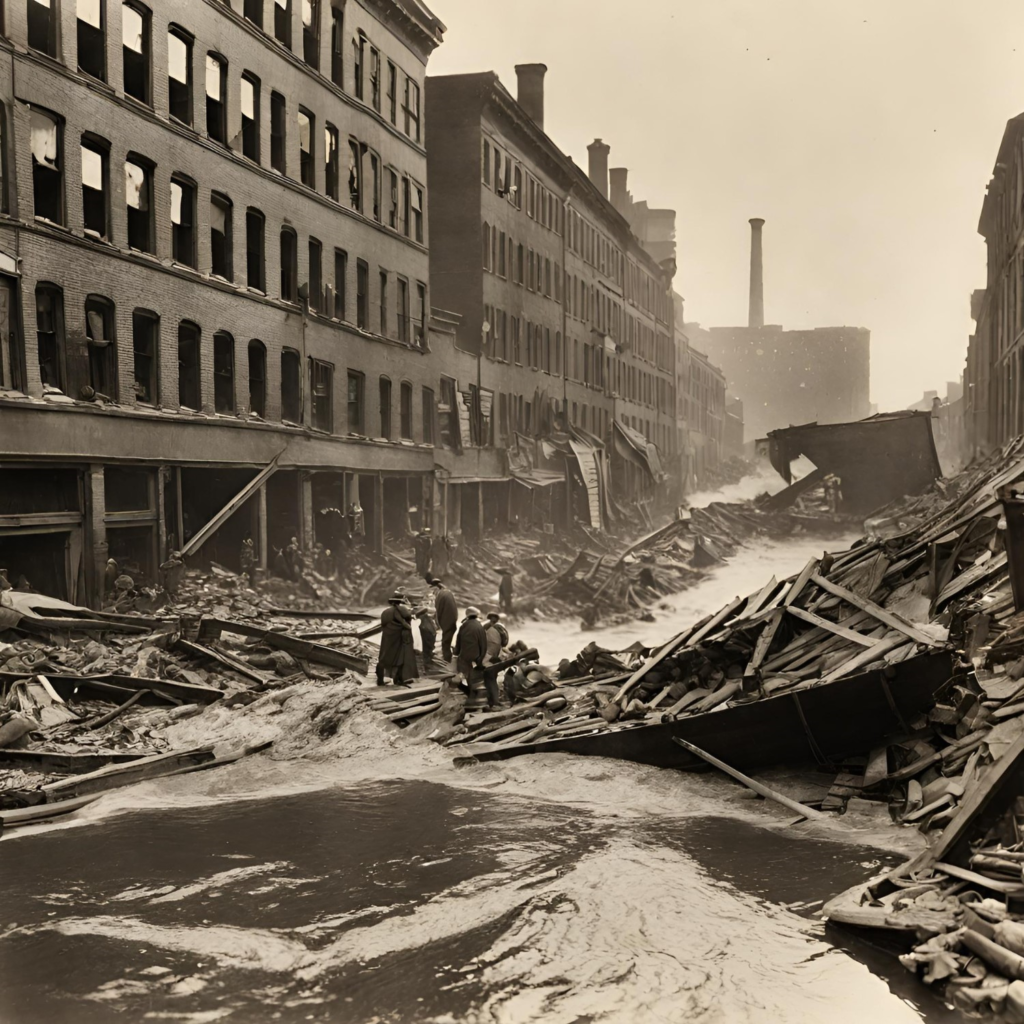
Prompt: Create a historically accurate picture of the Boston molasses flood of 1919.
Reflection
The essay hits on all of the major points and pretty well at that and even looks at specific techniques and processes. I wonder if because this is a fairly recent topic with lots of literature about it available online, then it was fairly simple for the AI to compile by just looking these sources and paraphrasing them into roughly two pages.
As for the picture that the AI generated, it looks fine from a distance but zooming in shows just overall weirdness. I think that it took the texture of broken buildings scattered around and the people around it from the actual pictures of the Boston Molasses Flood but filled in the blanks with the brick buildings lining the street; these buildings are not present in any pictures from the Boston Molasses Flood that I have seen but appear distinctively Bostonian. Additionally, the building components seem to flow from itself instead of being rigid and people just look like misaligned blobs when you look closer.
I think using AI in this sense falls right next to using Wikipedia in usefulness for research. It provides you with excellent starting off points but the significance and accuracy leave room to be desired. I would use AI to provide me with an overview of a subject (and let the professor know of the prompt and output of course) and create a list of what to research from that, but placing your full trust in it can definitely lead you astray.
1/24/2024 – Reviewing Four DH Projects
Rosenzweig Prize 2014: Civil War in Kansas
What I enjoyed:
- Themed colors with the time: blue, gray, brown like the pictures, red of blood?
- Featured documents and essays help allure viewers to view more
- I like how the sections bar is repeated in the sidebar as well
- The pages aren’t too big and don’t require a marathon of scrolling to see
- Images are easy to see!
- The timeline is a great choice with fine scrolling through to see every event or scrolling through by year
What could be changed IMHO:
- The animation for the topic A-Z list is an unnecessary flair
- Needs organization by topic for proper searching
Trans-Atlantic Slave Trade Database
What I enjoyed:
- There is an incredible amount of sheer data with many, many fields
- 5 total databases!
- The 3d models are a nice touch!
- I like using the timeline as a graph plotting # of captives by year
- There is a lot of easily exportable data
- The lesson plans page is in a different, poppier format
What could be changed IMHO:
- This site is made for researchers, not as much normal people
- This results in a trade off in aesthetics
- But really I am just nitpicking. This is a fantastic site
- This results in a trade off in aesthetics
Valley of the Shadow:
- I like the intro page with the two options: Explore the valley or about
- The goal is to make the site appealing and accessible, and it delivers on that goal
- There are three major sections separated by time (Eve of the War, War Years, and Aftermath) with subsections for each type of source used
- There are a section type of sections at the bottom (timelines, the two counties, sources, about and site map)
- The site map was very helpful in understanding the site’s layout BUT didn’t show these sections in it.
- Animations are brief and not flashy at all, very welcome
- Great formatting and aesthetics overall. Very readable and understanding of which county by the colors red or blue.
What could be changed IMHO:
- It was tough to find those secondary sections as they weren’t listed in the site map or at the top of the page
Burning Down the House: Slavery and Arson in America
For this entry, I will be talking more about the methodology used
- They examined historical arson and the blank history before the fire that it leaves behind using
- Environmental analysis
- Wooded environments covered up arson from accidental fires
- Allowed fires to spread easily and cause lots of destruction, not limited to small bounds
- Textual/Historical Analysis
- Looking at arson and slave revolts and adding that into context
- Uses of “fiery” language and fear
- In short, how arson was used as a tool for fear that erased history
- Environmental analysis
1/19/2024 – HIST 428 Omeka Site Review
Our assignment was to look at two previously completed Digital History Projects and review them. Using these instructions, here are my thoughts on the Digital History Project Archive site and the site for searching the register and graves of those interred at the Fredericksburg National Cemetery.
Digital History Project Archive:
- I thought this was a very interesting idea and project to embark upon and looking into this website not only helped me look at a fantastic website design but also helped me get a taste for what to expect in this oncoming semester.
- I loved the organization, theme, format, layout, and accessibility of the whole site. I quickly felt confident that I would be able to accurately see all corners of the website and know what I was looking at. In short, navigation is to the point, specific and easy to predict.
- I wonder if the relatively short source list enabled this group to be able to manually tag all sites with topics and years leading for very smooth searching by topic
- The search box on the left was very helpful!
- Everything is explained concisely and specifically.
- The dark mode moon symbol switching to a sun is a nice touch.
- This site is amazing, a role model perhaps.
Fredericksburg National Cemetary
- There are very detailed search instructions that took me a few minutes to read through. With all of the caveats involved, this seems much harder than it should be and some parts, like the redundant 0’s should have been automated
- But I guess easier said than done.
- There is a good use of acknowledging the limitations of the site. Very important to be honest with that.
- The hand drawn map is VERY IMPRESSIVE! Wow.
- Additionally, the star of the show is the digital map. This truly takes the cake being very accessible and easy to use. Love it!
- There is a very thorough history of the cemetery which definitely helps provide the context of the site
- I thought it was interesting how some graves have multiple soldiers and some soldiers have multiple grave numbers
- A few deltas:
- There are two different total grave numbers on the “how to search” page.
- Why are the Binding, Blank Pages and Cover above the actual register itself?
- The browse exhibits section has no exhibits in it.
1/16/2024 – HIST 428 Intro Blog Post
- Why am I taking this class?
- I am taking this class because it is a perfect intersection to learn digital literacy while also diving head over heels into my love for history. I am hoping to improve my digital literacy skills on multiple programs and learn many ways to tackle complex research questions using digital tools
- What is Digital History? What is (are?) Digital Humanities? How are they different?
- Digital History is the belief/movement/new genre of history based on the belief that resources for all historians should be democratized and easily accessible to all members of the public on the World Wide Web. Digital Humanities encompasses digital history and is the multidisciplinary, collaborative efforts using digital tools to learn more about and publicly display certain historical topics.
Hello world!
Welcome to Sites@UMW. This is your first post. Edit or delete it, then start writing!